From idea to impact: Hackathon for Good challenges Saints to solve real-world problems
"We asked our students to do something harder than build clever software. We asked them to use their creativity to build something for good."
- Radana Dvorak, Ph.D.
- Hackathon for Good
What can happen when business students, engineers and computer scientists are given 24 hours to tackle society's biggest challenges? The answer is innovation rooted in purpose.
During the inaugural Hackathon for Good on March 27-28, students traded sleep for brainstorming sessions, rapid prototyping and spirited debate as they worked across disciplines to transform ambitious ideas into practical solutions. The event challenged participants to design and build an application, tool or system that addressed a real-world need while promoting human flourishing. Grounded in at least one of Saint Martin's 10 Benedictine hallmarks, each project explored how technology could strengthen communities, support vulnerable populations or improve areas such as education, health, justice and environmental stewardship. Teams also developed a lean business plan and delivered a seven-minute pitch presenting both the problem and their proposed solution.
By the time teams delivered their final presentations to a panel of judges, they had done far more than complete an academic exercise. They experienced the kind of collaboration, creativity and problem-solving increasingly demanded in today's workforce.
"This event was exciting precisely because it asked our students to do something harder than build clever software," said Radana Dvorak, Ph.D., associate professor and chair of Saint Martin's computer science department. "It asked them to use their creativity to build something for good."
Each team anchored its project in at least one Benedictine hallmark, considering how values such as stewardship, community, hospitality and dignity could inform their work. In practice, that meant students were not simply writing code or developing business plans. They were wrestling with questions about how technology can serve people and strengthen communities.
For Dr. Dvorak, the Hackathon offered a chance to see students at their best.
Faculty watched students collaborate across majors, navigate disagreements under pressure and defend their ideas before judges. Just as importantly, they saw future professionals learning to apply technical knowledge through an ethical lens.
The projects themselves reflected that spirit of innovation with purpose.
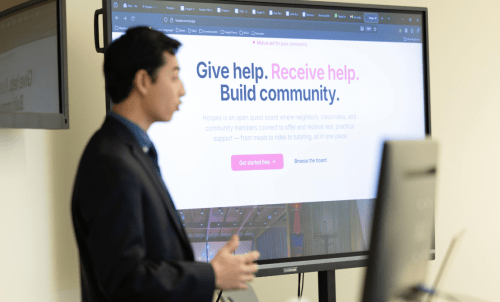
The winning team, Lemmar Wilson and Rocket Salas, developed StillGood, an app designed to connect surplus food with the people who need it most. Using a real-time interactive map, the platform helps donors quickly identify opportunities to share excess food before it goes to waste.
Wilson said the path to crating StillGood began with several hours of brainstorming that produced ideas ranging from practical to far-fetched.
"Competitions like this matter because hackathons teach you how to ship," Wilson said. "You're forced to make hard calls about what to actually build versus what to just talk about in the presentation, and you learn to deliver working code on a real deadline. That kind of pressure is hard to replicate in a normal class. It's also where I think engineering stops being theoretical and starts feeling like the job."
The runner-up project, SurvivalAI, focused on emergency preparedness. The offline-capable program provides real-time survival guidance and critical information during crisis situations, even when internet access is unavailable.
For students, the experience extended beyond competition. Projects like StillGood became opportunities to connect classroom learning with social responsibility and community impact.
Dvorak hopes many of the ideas generated during the Hackathon for Good will continue long after the awards are handed out.
Some projects could evolve into capstone experiences or undergraduate research opportunities. Others may continue to develop through community partnerships. Along the way, students gain valuable portfolio pieces that showcase their skills to future employers.
More importantly, they gain confidence in their ability to create meaningful change.
The Hackathon for Good exemplifies Saint Martin's longstanding commitment to educating the whole person through collaborative learning and real-world engagement. It brought together students with different areas of expertise and challenged them to think not only about what they could build, but why it mattered.
Computer Science
Ready to put your computer skills to use in a career serving others through future technologies? Computer science may be the best major for you.
- Campus
-
- Main (Lacey)
- Type of Instruction
-
- In Person
- Degree
-
- Bachelor of Science in Computer Science